

Juneteenth (The Other Independence Day)
Two and a half years after the Emancipation Proclamation, American slavery came to an end and a celebration of freedom was born. Juneteenth marks what is arguably the most significant event in American history after independence itself—the eradication of American slavery. It is also called Emancipation Day, Freedom Day, Jubilee Day, Juneteenth Independence Day, and Black Independence Day. It became celebrated as a national holiday in 2021.
Although the Emancipation Proclamation was issued by President Abraham Lincoln on September 22, 1862, it was not until June 19, 1865 that Union General Gordon Granger read federal orders inn Galveston, Texas. That General Order, No 3, became a date representing freedom of 250,000 enslaved people.
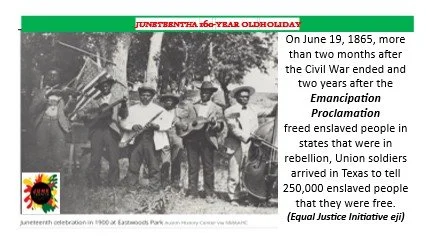
One might ask how the emancipation of Texas’ enslaved populations differed from other enslaved men and women. Earlier, enslavers in the states where the proclamation applied avoided emancipation by forcibly moving more than 150,000 enslaved Black people to Texas between 1862 and 1865. Elvira Boles, a formerly enslaved woman, lost her baby during the journey to Texas from Mississippi. “We was free and didn’t know it,” she said. After the June 19 announcement, Ms. Boles’ enslaver just “turned us loss in the world, without a penny.” (Equal Justice Initiative eji)
Some enslavers abandoned formerly enslaved people with no resources. In some Texas counties, enslavers hid the announcement for nearly a year until the Army reached the entire state. Some enslavers killed Black people rather than allow them to be free (Equal Justice Initiative eji). Some historians argue that many states enacted similar anti-emancipation practices as Texas.
Blog Prompt:
What, if any, celebrations are planned in your community for Juneteenth? What of this story should be shared with others? Will knowing the history make a difference? If so, How?
Post your response below: